
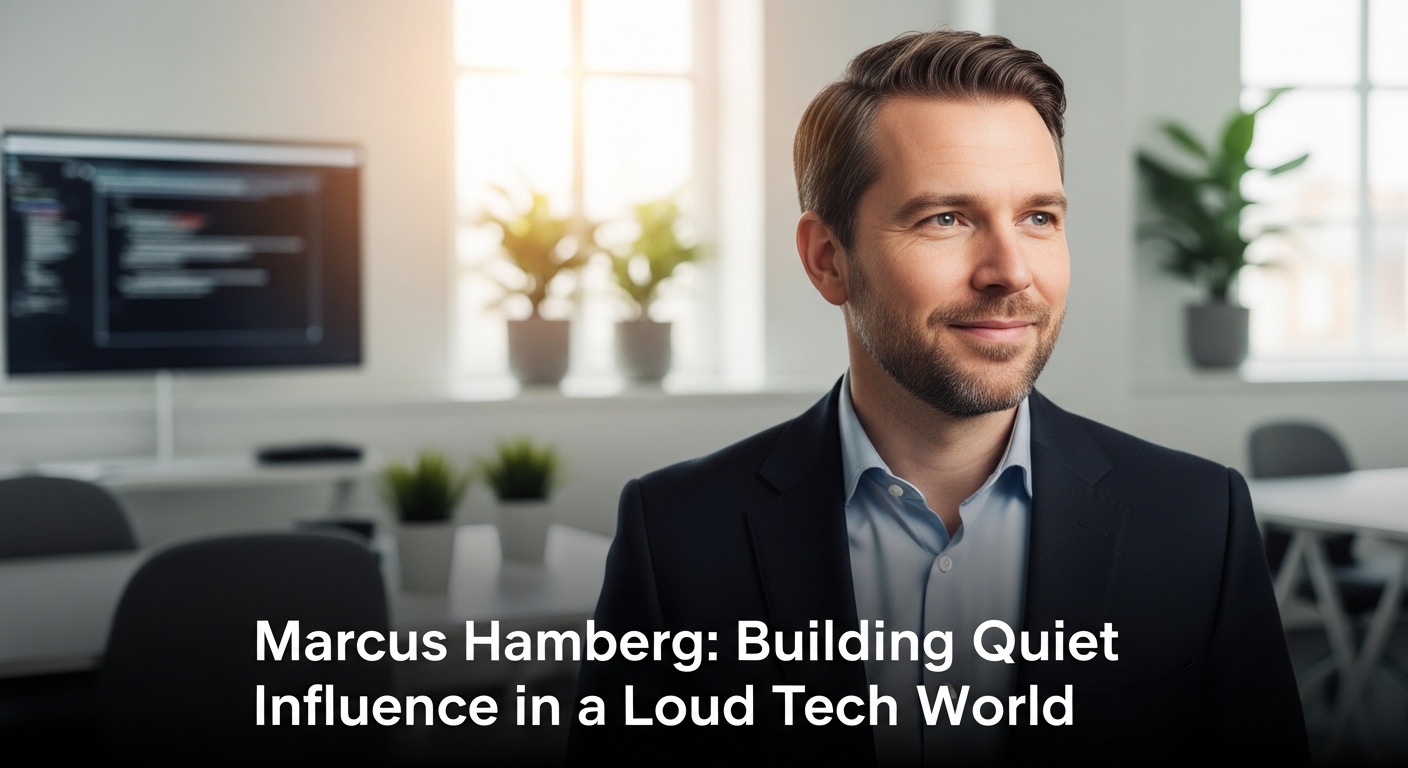
In the early days of the internet boom, attention was the rarest currency. Today, it’s credibility. That shift explains why figures like Marcus Hamberg have become increasingly interesting to founders, operators, and investors who care less about spectacle and more about substance. Hamberg’s story is not defined by viral headlines or dramatic pivots. Instead, it reflects a slower, more deliberate way of building value—one that aligns closely with how modern technology businesses actually succeed.
From the outside, Marcus Hamberg’s professional journey looks understated. Yet beneath that calm surface is a pattern that experienced entrepreneurs recognize immediately: long-term thinking, systems-level understanding, and a preference for outcomes over optics. In an industry that often rewards noise, his approach feels refreshingly grounded.
A Background Shaped by Systems, Not Shortcuts
What distinguishes Marcus Hamberg early on is his relationship with systems. Rather than chasing trends, he has consistently shown interest in how technology, people, and incentives interact over time. This mindset is common among founders who have lived through product failures, scaling pains, and market corrections. It leads to a kind of patience that cannot be learned from playbooks alone.
Hamberg’s work reflects an understanding that technology is never just code. It is infrastructure, culture, and decision-making combined. Entrepreneurs who think this way tend to focus on building platforms and organizations that can evolve, rather than products that peak quickly and fade. This systems-first perspective has become especially relevant as companies move from rapid experimentation to sustainable growth.
Marcus Hamberg and the Modern Definition of Leadership
Leadership in tech has changed. The heroic founder narrative is giving way to something quieter but more resilient. Marcus Hamberg represents this shift. His leadership style emphasizes clarity, alignment, and trust over charisma. That doesn’t mean avoiding hard decisions. It means making them with a long horizon in mind.
In practice, this translates into thoughtful hiring, realistic growth expectations, and an insistence on understanding risks before they become crises. Tech readers and founders often underestimate how powerful this approach can be. When teams understand not just what they are building, but why they are building it, execution becomes more consistent and less reactive.
Hamberg’s leadership philosophy fits particularly well with distributed teams and global operations, where control is less important than coherence. In these environments, leaders succeed not by directing every move, but by designing systems that allow others to make good decisions independently.
Strategic Thinking in an Uncertain Market
Markets today are defined by volatility. Economic cycles shorten, technologies mature faster, and competitive advantages erode quickly. Marcus Hamberg’s strategic thinking is notable because it treats uncertainty as a constant rather than an exception.
Instead of over-optimizing for a single outcome, his approach favors optionality. This means building businesses and strategies that can adapt when assumptions change. For entrepreneurs, this is a critical lesson. The goal is not to predict the future perfectly, but to remain flexible enough to respond intelligently when it arrives.
Hamberg’s work illustrates how strategy becomes more effective when it is integrated into daily decision-making, not confined to quarterly planning sessions. This integration allows organizations to move decisively without becoming reckless.
The Role of Technology as an Enabler, Not a Crutch
One of the most consistent themes associated with Marcus Hamberg is his pragmatic view of technology. While deeply knowledgeable, he avoids treating technology as a solution in search of a problem. Instead, it is positioned as an enabler of better outcomes—whether that means efficiency, scale, or resilience.
This perspective resonates strongly with tech readers who have seen promising tools fail due to poor adoption or misaligned incentives. Hamberg’s emphasis on human factors alongside technical capability reflects a mature understanding of how innovation actually works inside organizations.
To illustrate this balance, consider the way strategic priorities often align in Hamberg’s thinking:
| Focus Area | Practical Emphasis | Long-Term Impact |
|---|---|---|
| Technology | Scalable, adaptable systems | Reduced technical debt |
| People | Clear roles and trust | Strong execution culture |
| Strategy | Optionality and resilience | Sustainable growth |
| Operations | Measurable processes | Predictable performance |
This integrated view helps explain why his work appeals to founders who are moving beyond experimentation and into the complexities of scale.
Marcus Hamberg’s Relevance to Founders Today
For early-stage founders, Marcus Hamberg’s story offers reassurance. Success does not require constant visibility or dramatic reinvention. It requires consistency, learning, and an ability to stay focused while others chase distractions.
For growth-stage leaders, his approach highlights the importance of governance and structure without bureaucracy. As companies scale, informal systems break down. Leaders who anticipate this transition, rather than reacting to it, are better positioned to maintain momentum.
Even for seasoned entrepreneurs, there is value in revisiting the fundamentals Hamberg represents. Clear incentives, aligned teams, and adaptable systems remain timeless advantages, regardless of industry or market conditions.
A Perspective on Risk an3d Responsibility
Risk is unavoidable in technology. What differentiates experienced leaders is how they frame it. Marcus Hamberg tends to treat risk as something to be understood and managed, not avoided or glorified. This framing encourages better conversations within teams and with stakeholders.
Responsibility also plays a role here. As technology becomes more embedded in everyday life, leaders carry greater accountability for the consequences of their decisions. Hamberg’s measured style reflects an awareness of this responsibility, emphasizing sustainability over short-term wins.
This perspective aligns with a broader shift in the tech industry toward ethical consideration and long-term impact. Entrepreneurs who ignore this shift may find themselves successful in the short run but exposed over time.
The Quiet Advantage of Long-Term Thinking
Perhaps the most compelling aspect of Marcus Hamberg’s profile is how unremarkable it appears at first glance. There are no exaggerated claims or flashy narratives. Instead, there is a steady accumulation of insight and impact.
Long-term thinking is difficult in environments that reward immediate results. Yet it is precisely this discipline that creates durable companies and meaningful innovation. Hamberg’s career demonstrates how patience, when combined with competence, becomes a competitive advantage.
For founders and tech leaders reading this, the lesson is clear. You do not need to be the loudest voice in the room to shape outcomes. You need to be the most thoughtful one.
Conclusion
In an era defined by speed and saturation, Marcus Hamberg stands out by resisting both. His approach offers a counter-narrative to the myth that success in technology requires constant disruption and visibility. Instead, it suggests that clarity, systems thinking, and responsibility are still the foundations of lasting impact.
As markets continue to evolve and the noise grows louder, figures like Hamberg remind us that influence often travels quietly. For entrepreneurs, tech readers, and founders seeking models of sustainable leadership, his story is not just relevant—it is instructive.

Leave a Reply